
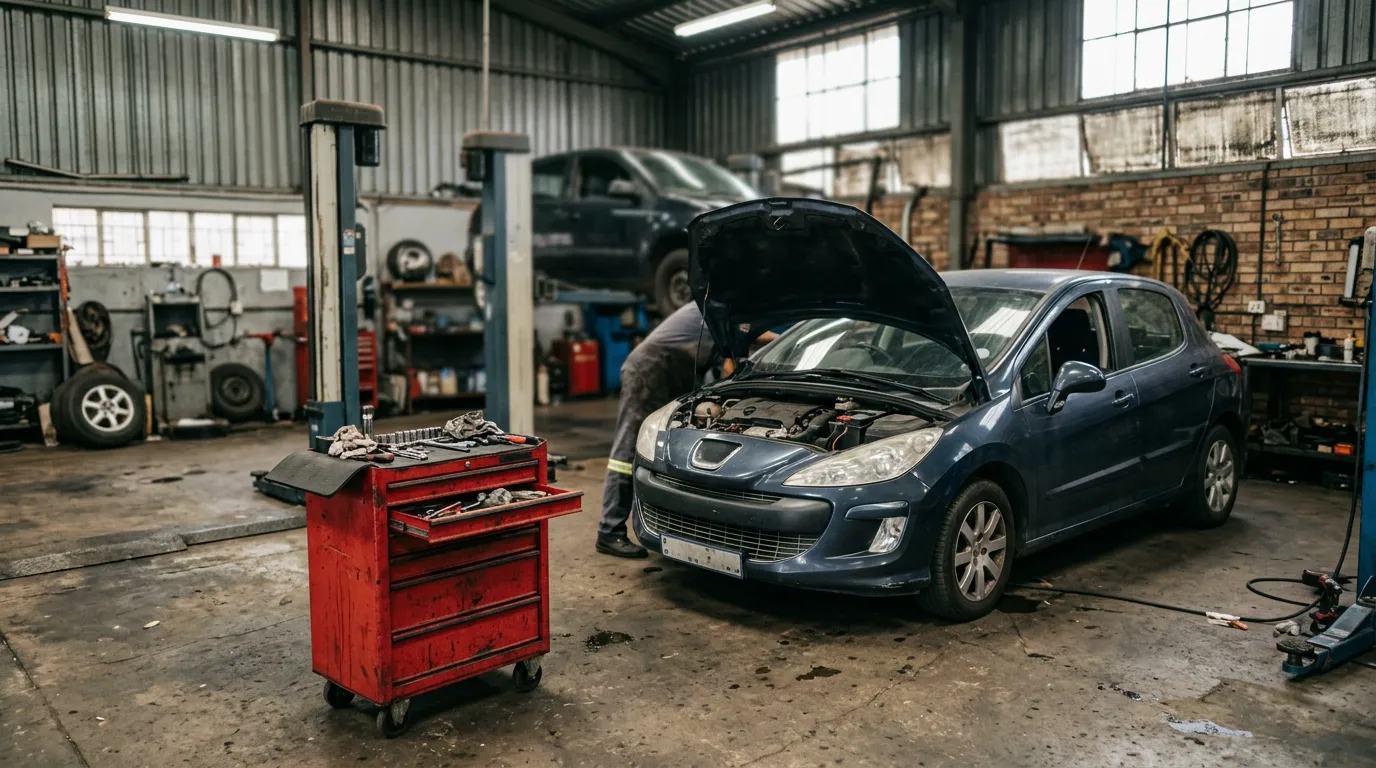
Peugeot 1.5 BlueHDi Timing Chain Recall R/2025/246: Nine Models, Nine Build Windows

Key Takeaways
| Recall fact | Detail | Cost to you |
|---|---|---|
| Recall reference | R/2025/246 (UK DVSA), launched 3 July 2025 | — |
| Manufacturer campaign code | MXL-251380CO — this is the reference a dealer's system actually holds | — |
| Engine | 1.5 BlueHDi diesel, engine family DV5R — chain-driven, not a wet belt | — |
| Defect | "premature wearing of the camshaft drive chain leading to abnormal noise or to a breakage of the chain in the worst case" | — |
| Models in scope | Nine — 508, 3008, 5008, Partner, Rifter, Traveller, 208, 2008, 308 — each with its own build start date | — |
| Build window | There is no single window. Starts range from 11 January 2017 (508) to 13 January 2021 (308) | — |
| Remedy | Software update for oil pressure, engine noise check, chain replaced if required, otherwise an oil change to a higher-viscosity anti-wear oil | R0 — recall work is manufacturer-funded |
| South Africa | UK register only. SA campaigns are administered separately and decided per VIN | VIN check is free |
If you drive a Peugeot with the 1.5 BlueHDi diesel, you have probably seen a headline about a camshaft chain recall and a build window running from October 2017 to January 2023. That window is real, but it is not your window — unless you happen to own a 3008 or a 5008. The UK safety register that this recall comes from lists nine separate Peugeot models with nine separate build start dates, and the gap between the earliest and the latest is four years. A 2020-built 308 falls outside it. A 2018-built Partner falls inside it. This guide prints the register's actual per-model dates, gives you the manufacturer campaign code to quote at a dealer, explains why the fix is partly an oil change, and tells you honestly what we can and cannot establish about South Africa.
What Recall R/2025/246 Actually Says
The recall was launched on 3 July 2025 and sits on the UK Driver and Vehicle Standards Agency's public register under the title Peugeot DV5R Engines Camshaft Chain [1][2].
The defect wording, verbatim from the register, is:
"Vehicles may be affected by premature wearing of the camshaft drive chain leading to abnormal noise or to a breakage of the chain in the worst case."
And the remedy, also verbatim:
"Update the software to improve oil pressure and reduce wear. Check the engine noise and replace the chain if required. If no problem found change the oil to one with higher viscosity and special anti-wear additives."
Read that remedy twice, because it is unusual. It is not a straight parts replacement. It is a decision tree: reflash first, listen second, replace the chain only if the noise says so — and if the chain is judged fine, the car goes out on a different oil. Two of the three branches are about oil pressure and oil specification [1].
One thing the register does not publish for this recall is a VIN range. The VIN Start and VIN End fields are blank on all nine model rows [1]. There is no list you can check your VIN against yourself — a VIN lookup through the manufacturer is the only test.
Quote MXL-251380CO, Not R/2025/246
This is the single most practical thing in this guide. R/2025/246 is the regulator's reference — it is how the DVSA files the campaign on its public register. The manufacturer's own campaign code is MXL-251380CO, and that is the number that exists inside a Stellantis dealer's system [1].
If you phone a service desk and lead with the regulator's alert number, you are giving them a reference their software does not search on. Lead with your 17-character VIN, then offer the campaign code MXL-251380CO, then mention R/2025/246 as the public reference if they want it. That order gets you an answer faster.
The same engine campaign went out on the same day under sister codes for the other Stellantis brands, all carrying identical DV5R Engines Camshaft Chain defect text: Vauxhall R/2025/245 (KUH-251380CO), Citroën R/2025/247 (NY5-251380CO) and DS Automobiles R/2025/248 (NY5-251380CO) [1]. Worth knowing if you own a Berlingo or a Grandland alongside the Peugeot — it is the same engine.
Nine Models, Nine Different Build Windows
Here is the table almost nobody prints. Every date and every count below is taken straight from the DVSA's full recall dataset, one row per model [1]. Build dates are the register's own — the ends are mostly common, the starts are not.
| Model (as the register prints it) | Build start | Build end | UK vehicles |
|---|---|---|---|
| 508 V2 | 11 January 2017 * | 31 January 2023 | 2,073 |
| 3008 | 11 October 2017 | 31 January 2023 | 22,401 |
| 5008 | 11 October 2017 | 31 January 2023 | 9,133 |
| Partner | 18 November 2017 | 31 January 2023 | 26,138 |
| Rifter | 18 November 2017 | 31 January 2023 | 8,191 |
| Traveller | 18 January 2018 | 3 May 2022 | 338 |
| 208 | 16 April 2019 | 31 January 2023 | 2,251 |
| 2008 | 8 July 2019 | 31 January 2023 | 5,156 |
| 308 | 13 January 2021 | 31 January 2023 | 7,383 |
* The 508 row is the odd one. The register gives its build start as 11 January 2017, which is earlier than every other model on the list and earlier than the second-generation 508 went on sale. We have printed it as the register states it because that is what the register states — we have no second source that explains it and we are not going to quietly correct a safety register to make it tidier. Treat the 508 entry as a reason to check the VIN, not as a date to reason from [1].
Notice how much work those nine start dates do. The commonly-quoted 11 October 2017 is the 3008 and 5008 date only. The 308 does not enter the campaign until 13 January 2021 — more than three years later — and that is not an artefact of how the data was compiled. The DVSA's own model-year page for the 2019 Peugeot 308 does not list R/2025/246 at all, while the 2021 page does [5]. The register means it.
Model-by-model, the campaign is confirmed on the DVSA's public model pages for the 3008 [2], 208 [3], 2008 [4], 308 [5], 5008 [6] and Rifter [7], each returning R/2025/246 with the 3 July 2025 launch date.
What Is Not on the List
Just as useful as the nine models is the fact that the register does not name the Expert, the 301 or the 407 in this campaign [1]. If you have read elsewhere that the 301 is caught up in the DV5 chain campaign, the register does not support it.
Two of the nine also deserve a flag because they are quietly under-covered. The 508 (second generation) is in scope, and so is the Traveller — neither appears in most of the model lists doing the rounds. And the 5008 carries one of the two earliest build starts along with 9,133 UK cars, a bigger population than the 308. Our 5008 fault-by-fault breakdown covers what else goes wrong on that car, and the 3008 problems guide does the same for the model with the largest count on the list.
Why We Will Not Give You a Single Total
You will see a headline number attached to this recall. Be careful with it. The DVSA publishes the vehicle count per model, not per campaign — there is no official total anywhere in the record [1]. The 22,401 figure that gets quoted is the 3008 row on its own, and it is correct only for the 3008.
If you want a sense of scale, the honest way to put it is this: the nine Peugeot rows in the DVSA register add up to just over 83,000 UK vehicles. That is our own addition of nine published numbers, not a figure the register states, and we are labelling it as such.
The 1.5 BlueHDi Is Chain-Driven — This Is Not the Wet-Belt Story
This trips up a lot of owners, and it matters because the two failures have nothing in common.
The recall title names the camshaft chain, and the defect describes premature wearing of the camshaft drive chain [1][2]. The manufacturer and the regulator are both describing a chain, in the same document.
So: no wet belt, no rubber running in oil, no belt-shredding-into-the-oil-pickup failure. That is the 1.2 PureTech petrol story and it is a different engine with a different problem.
The engine-code map is worth committing to memory, because it decides which parts you buy:
- DV5 is the 1.5 litre. Chain-driven, and the subject of this recall [1].
- DV6 is the 1.6 litre. It is a different engine family from the DV5, so DV5R chain parts are not interchangeable with it.
- DW10 is the 2.0 litre BlueHDi. Also belt-driven. NTN-SNR's own fitting bulletin is titled When fitting a new timing belt kit on the 2.0 BlueHdi DW10F type engine — about as unambiguous as sourcing gets [12].
If you want the full belt-or-chain answer for every Peugeot engine, that is exactly what our Peugeot timing belt vs chain guide is for.
One more separation worth making: the 1.5 BlueHDi also has a well-known set of AdBlue and SCR faults, and those are a completely different failure mode on the same engine — covered in our BlueHDi AdBlue and SCR guide. A chain problem and an AdBlue problem on the same car are not related, and neither one is evidence of the other.
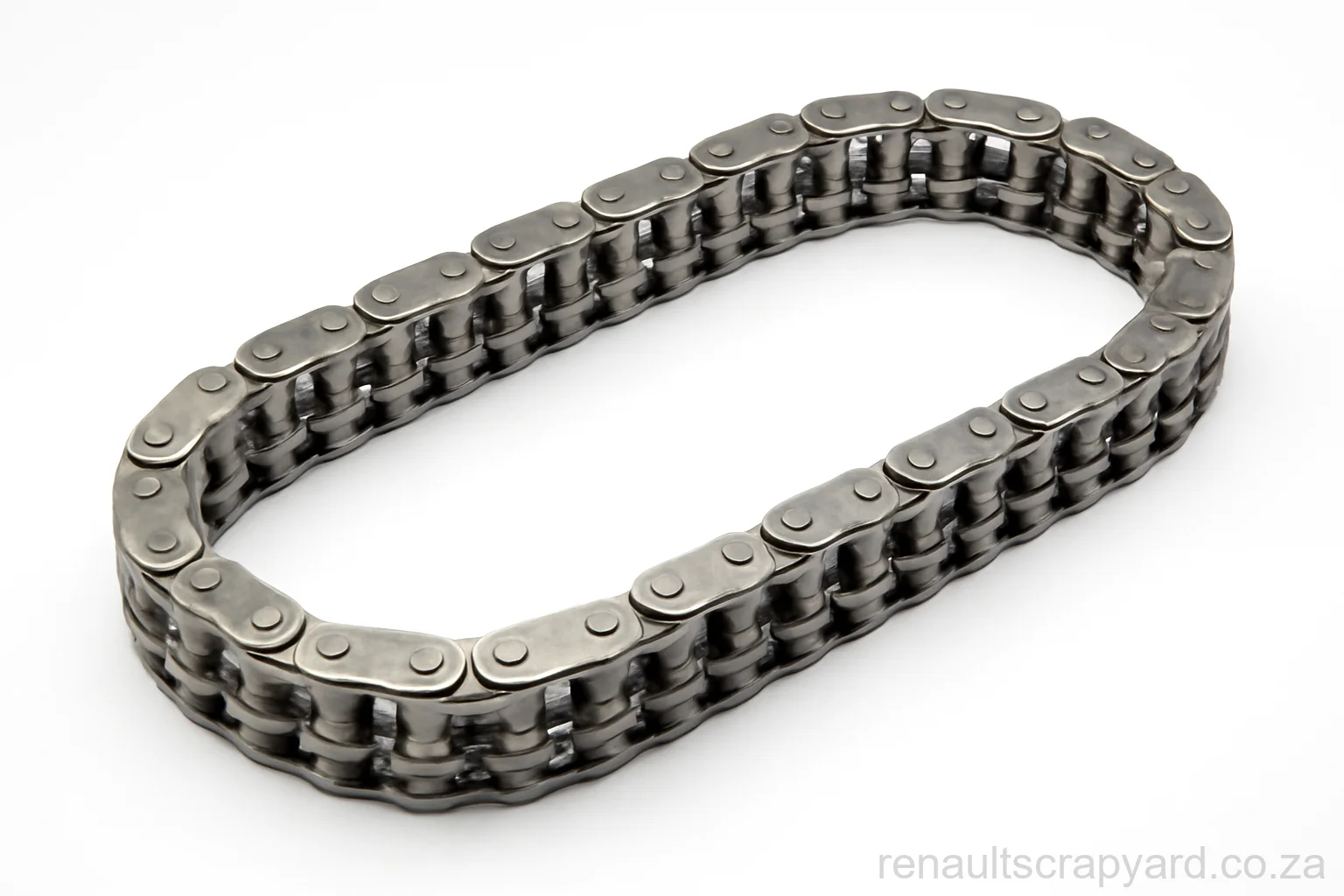
Need a DV5R timing chain kit?
If your dealer has decided the chain goes, or you are working outside a campaign, we source OEM and quality aftermarket DV5R chain kits — chain, guides, tensioner and sprockets. Send us your VIN and we will match the right kit for your build rather than the nearest one.
Get Quote →The Oil Angle — Why the Fix Is Partly an Oil Change
This is the practical heart of the whole story, and it is the part that most coverage skips over on the way to the drama of a broken chain.
Look again at the official remedy. It names oil twice: "update the software to improve oil pressure and reduce wear", and "if no problem found change the oil to one with higher viscosity and special anti-wear additives" [1]. That is the manufacturer's own remedy telling you that oil pressure and oil chemistry are load-bearing on this chain. It is not a theory somebody on a forum put forward.
The Oil Specification, Precisely
Here is where a lot of SA owners get given the wrong thing over a parts counter.
A BlueHDi engine fitted with SCR takes PSA B71 2312, and B71 2312 is a 0W-30 approval [9][10]. Motul's own application guidance spells out the split: its B71 2290 product covers most PSA petrol and diesel engines including DPF versions, except for BlueHDi diesels fitted with SCR — for those, the 2312 0W-30 [9][10].
Two consequences follow, and both are worth arguing about at the counter:
- "5W-30 PSA B71 2312" does not exist. It is a combination you will nonetheless be offered. B71 2312 is a 0W-30 approval. If the bottle says 5W-30 and B71 2312 on the same label, something is wrong [9][10].
- B71 2312 is mid-SAPS, not low-SAPS. ACEA C2 and C3 are mid-SAPS categories; in the current ACEA sequence only C4 is low-SAPS, and the old C1 category is obsolete [11]. Plenty of listings get this backwards.
Given a recall whose fallback remedy is literally "change the oil to one with higher viscosity and special anti-wear additives", being casual about oil grade on a DV5R is not a small thing. Our Peugeot oil change guide for SA owners covers grades, capacities and intervals across the range if you want the wider picture.
Do Not Let Anyone Substitute the Grade
If your car has SCR and AdBlue, the approval you want on the bottle is PSA B71 2312 in 0W-30. Not a 5W-30 with a B71 2312 claim. Not a general BlueHDi oil. On an engine whose own recall remedy is an oil-pressure software update plus an oil change, a "close enough" grade is the wrong economy.
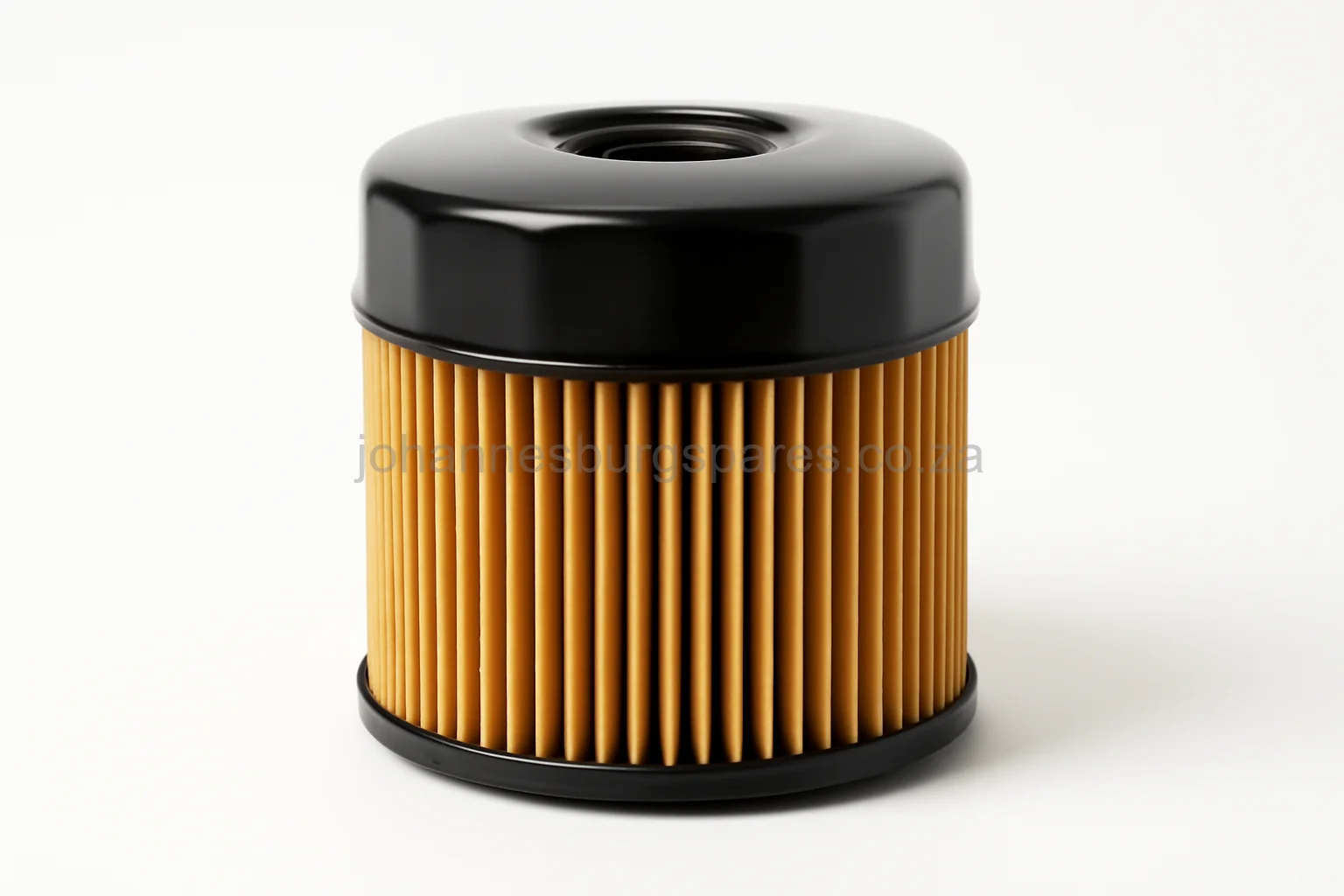
Sorting the oil side properly?
Oil filter, sump plug seal and the correct 0W-30 PSA B71 2312 oil for a 1.5 BlueHDi with SCR — quoted as one job so nothing gets substituted for the nearest grade on the shelf. Give us your VIN and we will confirm the filter for your exact build.
Get Quote →What Does It Cost?
We are not going to give you a rand figure, because the recall record does not contain one and the honest answer is that it depends entirely on which branch of the remedy your car takes.
The remedy is a decision tree [1]. If the dealer runs the software update, checks the engine noise, finds nothing and sends the car out on a different oil, that is a short shop visit. If the noise check goes the other way and the chain is replaced, that is a substantially bigger job on a diesel engine. Nothing in the register quantifies how often it goes one way or the other, and we are not going to guess at a split we cannot source.
Where the campaign applies to your car, the work itself is manufacturer-funded — that is what makes it a recall rather than a service bulletin. What we would not do is budget for the software update and be surprised by a chain.
Symptoms — And an Honest Note About Them
The register gives exactly one symptom: abnormal noise [1]. That is the whole of it.
You will find plenty of pages that tell you a rattle on cold start is the first sign, that it starts at a particular mileage, or that it is more common on one model than another. We have not been able to find a source of any standing that ranks the symptoms, times their onset, or gives a failure rate for the DV5R chain — no denominator, no sample size, nothing. So we are not going to print one.
What we would act on: a new mechanical noise from the cam-drive end of the engine that was not there before, particularly one that changes with engine speed. That is worth a diagnosis on any engine. On a DV5R inside one of the nine build windows above, it is worth a diagnosis and a VIN check on the same day.
South Africa: What We Can and Cannot Tell You
We are going to be blunt here, because this is the question everyone lands on this page for and it is the one most easily answered dishonestly.
R/2025/246 is a United Kingdom record. It lives on the DVSA register, it uses UK build data and it counts UK vehicles. South African recall campaigns are administered separately — by Peugeot South Africa and the National Consumer Commission — and they are decided per VIN, not per build date.
We cannot tell you that South African cars are covered by this campaign. We also cannot tell you that they are not. We have found no South African record either way, and we are not prepared to turn that gap into a confident sentence in either direction.
Two further things we will not claim, for the same reason. BlueHDi-badged Peugeots certainly do trade in South Africa — but "BlueHDi" covers the 1.5, the 1.6 and the 2.0, and we have not been able to establish from a South African source which models were sold here with the 1.5 specifically. And the Stellantis warranty extension described in the next section is a UK measure reported by a UK publication; we have found no South African equivalent.
One narrower point we are reasonably confident about: every South African 208 source we have found from the 2015 facelift onwards lists petrol engines only. Since the DV5 does not enter the 208 until 16 April 2019 [1], an SA-market 1.5 BlueHDi 208 looks very unlikely — though again, your VIN settles it and our reading of brochures does not.
All of which points at exactly one action, and it happens to be free.
South African Context — Check the VIN, Not the Build Date
Go to peugeot.co.za/owners/maintain-your-car/recall.html and enter your 17-character VIN — the tool expects a VIN starting VF3 or VR3. If you would rather speak to someone, Peugeot SA customer care is on 0860 738 472. Any authorised Peugeot dealer can also run the check at the service desk — give them the VIN first and the campaign code MXL-251380CO second [13].
The Stellantis Camshaft Chain Warranty Extension — and Why It Has Closed
Separate from the recall, and frequently confused with it, Stellantis put a coverage extension in place for camshaft chain issues on the 1.5 BlueHDi. As reported by Parkers in July 2025, it ran to 10 years or 150,000 miles and specifically covered camshaft chain issues, on cars built between October 2017 and January 2023 [8].
Two important qualifications.
First, it is not the recall. The recall is manufacturer-funded corrective work under a safety campaign. The extension was a warranty and reimbursement backstop — a way for owners who had already paid for a chain to claim it back. They overlap in scope but they are different instruments, and conflating them will get you the wrong answer at a dealer.
Second — and this is the bit that has gone stale everywhere on the internet — the reimbursement window has expired. It covered repairs carried out between 1 January 2023 and 30 June 2025 [8]. That closed well over a year ago. Any page still telling you to go and claim your money back is out of date. If you paid for a DV5R chain during that window and never claimed, it is still worth a phone call, but go in expecting a closed window rather than an open one.
Note also that Parkers gives the build range only to month precision — "October 2017 to January 2023" [8]. The day-precise, per-model dates in the table above come from the DVSA register, not from press coverage, and they are the ones to reason from [1].
What To Do Now
- Find your VIN and your build date. Both are on the VIN plate or in the service book. Build date, not registration date — an imported or dealer-stocked car can be registered six to twelve months after it was built.
- Check your model's row in the table above. The starts differ by four years across the nine models. Do not use the 3008 window for a 308.
- Run the VIN through peugeot.co.za/owners/maintain-your-car/recall.html or call 0860 738 472 [13]. This is the only test that settles anything, because the register publishes no VIN range at all [1].
- If you speak to a dealer, quote MXL-251380CO — the manufacturer campaign code — rather than R/2025/246, which is the regulator's public reference [1].
- Get the oil right regardless. 0W-30, PSA B71 2312 for a BlueHDi with SCR [9][10]. Whatever the campaign says about your car, this part is in your hands.
Get the Right DV5R Parts First Time
The awkward part of a chain campaign is that the parts side is unforgiving. A kit that fits the engine family is not necessarily the kit that fits your build. That is a VIN question, not a model-year question — which is the same reason we ask for a VIN on every quote rather than a model name.
1.5 BlueHDi Chain or Oil Parts? Quote in 24 Hours.
Send us your VIN and what you need — DV5R timing chain kits matched to your VIN, guides, tensioners, sprockets, oil filters and the right 0W-30 PSA B71 2312 oil for an SCR BlueHDi. We come back with OEM, reconditioned and quality aftermarket options and nationwide delivery times.
Frequently Asked Questions
Which Peugeot models are covered by recall R/2025/246?
Nine: the 508 (second generation), 3008, 5008, Partner, Rifter, Traveller, 208, 2008 and 308, all with the 1.5 BlueHDi DV5R diesel [1]. The register does not name the Expert, the 301 or the 407 in this campaign. Each of the nine has its own build start date, so being the right model is only half the test.
What is the build window for the Peugeot 1.5 BlueHDi chain recall?
There isn't one. That is the point most coverage misses. The DVSA register lists a separate build window per model, with starts ranging from 11 January 2017 for the 508 to 13 January 2021 for the 308 [1]. The widely quoted 11 October 2017 date belongs to the 3008 and 5008 only. Use the per-model table above.
What is the difference between R/2025/246 and MXL-251380CO?
R/2025/246 is the UK regulator's reference — how the DVSA files the campaign publicly. MXL-251380CO is Peugeot's own manufacturer campaign code, and it is the reference a dealer's system holds [1]. Quote your VIN first and the campaign code second; the regulator's alert number is the one least likely to return a result at a service desk.
Does the Peugeot 1.5 BlueHDi have a timing belt or a timing chain?
A chain. The recall is titled Peugeot DV5R Engines Camshaft Chain and the defect describes premature wearing of the camshaft drive chain [1][2]. This is not the wet-belt problem — that belongs to the 1.2 PureTech petrol. The 2.0 BlueHDi (DW10) is belt-driven, which is a different job again [12].
Does recall R/2025/246 apply to South African Peugeots?
We cannot tell you either way, and nobody honestly can from the public record. R/2025/246 is a UK DVSA record built on UK data. South African campaigns are administered separately by Peugeot South Africa and the National Consumer Commission, and are decided per VIN rather than per build date. Check yours at peugeot.co.za/owners/maintain-your-car/recall.html or call 0860 738 472 [13].
What oil does a Peugeot 1.5 BlueHDi take?
A BlueHDi fitted with SCR takes PSA B71 2312, which is a 0W-30 approval [9][10]. There is no such product as a 5W-30 PSA B71 2312 — if a label claims both, something is wrong. B71 2312 is mid-SAPS, not low-SAPS: ACEA C2 and C3 are mid-SAPS categories; in the current ACEA sequence only C4 is low-SAPS, and the old C1 category is obsolete [11].
What does the recall repair actually involve?
A decision tree rather than a fixed job. The remedy is to update the software to improve oil pressure and reduce wear, check the engine noise, replace the chain if required, and if no problem is found, change the oil to one with higher viscosity and special anti-wear additives [1]. So the cost depends entirely on whether the dealer stops at the software update or goes on to the chain.
Can I still claim the Stellantis camshaft chain reimbursement?
The reimbursement window has closed. Stellantis extended coverage to 10 years or 150,000 miles for camshaft chain issues, with reimbursement for repairs carried out between 1 January 2023 and 30 June 2025 [8]. That period ended over a year ago. It was also a UK measure reported by a UK publication — we have found no South African equivalent.
How many vehicles are affected by the DV5R chain recall?
The DVSA publishes counts per model, not per campaign, so there is no official total [1]. The individual Peugeot rows run from 338 Travellers to 26,138 Partners, with 22,401 for the 3008. Added together the nine Peugeot rows come to just over 83,000 UK vehicles — that is our arithmetic on nine published figures, not a number the register states.
Sources
- All recalls since 1992 — full recall dataset (CSV) (DVSA, Check Vehicle Recalls service — primary source for the recall number, launch date, defect and remedy wording, manufacturer reference, per-model build dates and per-model vehicle counts)
- Peugeot 3008 (2017) recalls (DVSA — lists R/2025/246, Peugeot DV5R Engines Camshaft Chain)
- Peugeot 208 (2020) recalls (DVSA)
- Peugeot 2008 (2020) recalls (DVSA)
- Peugeot 308 (2021) recalls (DVSA — the 2019 model-year page does not list this recall, matching the register's 13 January 2021 build start)
- Peugeot 5008 (2019) recalls (DVSA)
- Peugeot Rifter (2020) recalls (DVSA)
- Stellantis extends warranty on diesel engines (Parkers, 9 July 2025 — the 10-year / 150,000-mile camshaft chain coverage extension and the 1 January 2023 to 30 June 2025 reimbursement window)
- PSA / Peugeot Citroën oil specifications (oilspecifications.org — B71 2312 is for BlueHDi diesel engines fitted with SCR)
- MOTUL SPECIFIC 2312 0W-30 technical data sheet (Motul — confirms B71 2312 as a 0W-30 approval and the SCR BlueHDi exception to B71 2290)
- ACEA oil sequences explained (oilspecifications.org — C2 and C3 are mid-SAPS; C4 is low-SAPS; C1 is obsolete)
- When fitting a new timing belt kit on the 2.0 BlueHdi DW10F type engine (NTN-SNR fitting bulletin — confirms the 2.0 BlueHDi is belt-driven, not chain-driven)
- Recall campaigns (Peugeot South Africa — VIN recall checker accepting 17-character VINs starting VF3 or VR3, and customer care on 0860 738 472)
Important Disclaimer
This guide is informational and reflects forum, specialist and owner-reported patterns. It is not a substitute for diagnosis by a qualified Peugeot specialist. SA rand pricing is indicative and varies by region, supplier and parts source. Always confirm parts compatibility against your VIN before purchase. Pro Peugeot Spares is a parts supplier, not a workshop — we do not perform installation.
Important Disclaimer
This content is for informational purposes only and is based on research from automotive industry sources. Pro Peugeot Spares is not a certified automotive repair facility. Always consult with qualified automotive professionals before performing any repairs or maintenance. Improper repairs can result in personal injury, property damage, or vehicle malfunction. We assume no responsibility for actions taken based on this information.