
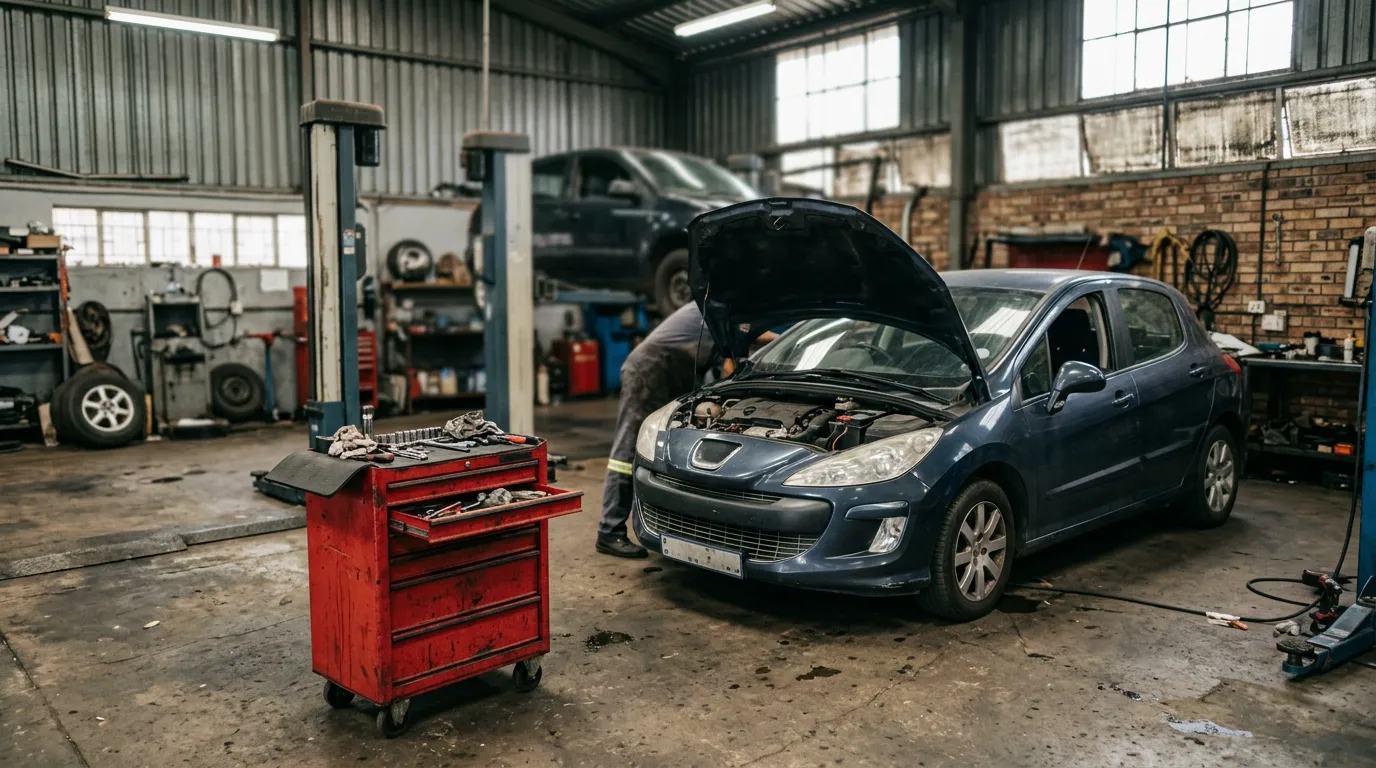
Peugeot BSI Water Ingress: Why Your Electrics Are Going Crazy

Key Takeaways
| Aspect | Details | SA Cost |
|---|---|---|
| What it is | BSI = Built-in Systems Interface, the central body computer | — |
| Affected SA models | 206, 207, 307, 308, 3008, 5008, 508, 407 — broadly the 206 era onwards | — |
| Primary cause | Blocked scuttle / sunroof drains let water pool on the BSI | — |
| Cheap preventive — drain clear | 15-minute DIY with compressed air | R0 – R1,500 |
| BSI reset procedure | Battery disconnect with timed sleep cycle | R0 – R800 |
| Shunt fuse / battery current sensor | Shunt fuse in the BSI fuse box; current sensor on the battery negative terminal | R200 – R1,800 |
| BSI specialist re-flash / rebuild | If module is damp but functional | Ask for a quote |
| BSI replacement and coding | If module is corroded beyond repair | Ask for a quote |
If your Peugeot is throwing four dashboard warning lights at once, draining the battery overnight, locking and unlocking itself, or losing infotainment for no obvious reason — there's a very good chance you don't have an electrical fault, you have a water leak. The BSI (Built-in Systems Interface) is the central body computer that runs the car's electrical functions, and on most Peugeots — from the 206 era through to the latest 508 — it sits low enough in the cabin, usually behind the glovebox, for leaked water to reach it. Blocked scuttle drains overflow onto the BSI, corrode the connector pins, and the module then behaves like a glitching brain — cascading symptoms across unrelated systems. This guide explains what the BSI is, why it fails, and how to fix it cheaply before the dampness turns it into a module replacement.
What Is the BSI?
The Built-in Systems Interface — Peugeot's French engineering documentation calls it Boîtier de Servitude Intelligent, abbreviated BSI on every model — is the central body computer. It runs the lighting, central locking, alarm, immobiliser, wipers, indicators, power windows, climate control, and the messaging between the engine ECU and the dashboard cluster [1]. On modern Peugeots the BSI is also the gateway between the car's CAN networks, so a BSI fault shows up as lost communication with other controllers — one 308 owner's scan reported comms failures with the ABS/ESP unit, the steering-wheel controls, the power steering and the airbag module all at once [2].
The BSI is supposed to enter sleep mode about three minutes after the ignition is off and all doors are closed. Failure to sleep — usually because water has reached the module or its connectors are corroded — is a common root cause of "Peugeot electrical gremlin" complaints [3].
South African Context
Cars left under jacaranda trees, in carports with leaf-litter, or simply outside in spring see their scuttle drains block faster than European cars. Coastal cars in Durban and Cape Town suffer the same fault accelerated by salt-laden air corroding connector pins and exposed contacts.
Why Water Reaches the BSI
The BSI sits in different places depending on the model — usually behind the glove box on the passenger side, sometimes under the driver's footwell, sometimes mounted high in the engine bay fuse box. The water source is almost always one of three paths:
- Blocked scuttle (plenum) drains under the windscreen wipers. Leaves and silt clog the drain channels. Water overflows into the engine bay and trickles down to the BSI [5][6].
- Blocked sunroof drains on cars fitted with an opening sunroof. A sunroof cassette normally drains through tubes at each corner, routed down the pillars, and these silt up [7]. Cars with a large fixed panoramic glass roof leak differently — the 5008's well-documented leak path shows up as a wet headliner [8].
- Perished door rubber seals and bulkhead grommets — older cars (206, 207, 307) where seals have hardened and shrunk. Water enters the cabin and the carpet wicks it toward the BSI tray.
The 307 BSI failure mechanism is particularly well-known — water leaks through the bulkhead seal or windscreen scuttle and pools onto the BSI module sited behind the glovebox; pins in the multi-plug connectors corrode and the module shorts intermittently [5]. The same pattern repeats on other models in different geometries.

BSI module, shunt fuse or seals?
Used BSI modules, shunt fuses, scuttle drain kits and door seals for Peugeot models including the 206, 207, 307, 308, 3008, 5008, 508 and 407.
Get Quote →The Cascade — What Symptoms Look Like
The BSI runs so many systems that water ingress symptoms cascade in patterns that look like several different failures at once. The classic complaint reads like this:
- Multiple unrelated dash warnings at once — ABS, ESP, airbag, brake — illuminated simultaneously, sometimes clearing after a restart and returning the next day
- Random central locking — remote works sometimes, sometimes only the key, sometimes the car locks and unlocks at 3 a.m.
- Ghost alarms at night
- Battery drain overnight — car will not start in the morning despite a healthy alternator and a recent drive
- "Charging fault" warning with a known-good alternator (the BSI is misreading the battery's state of charge — see below)
- Wipers and indicators misbehaving — wipers running with no input, indicators flashing in the wrong direction
- Infotainment / touchscreen rebooting — the screen never reaches standby because the BSI never sleeps
- Handbrake / EPB warning stuck on with no actual fault [10]
- Car won't start, or starts intermittently — immobiliser fault F527
Three or four of these together, especially after a wet week, is the classic BSI signature.
Diagnosis — Find the Water First
Never replace the BSI before finding and fixing the water. If you do, the new module dies the same way within months. The standard diagnostic sequence:
- Lift the bonnet and inspect the scuttle area under the wipers. Look for pooled water and decaying leaves in the channels. Note any silt around the drain holes [5].
- Lift the carpets in the front passenger and driver footwells. Press the underlay — if it squeezes water, the BSI is wet too.
- Inspect the boot floor on saloon and estate cars — 508 owners commonly report water collecting in the spare-wheel well, usually from perished boot-lid or rear-light seals, which is worth catching before it reaches wiring [11].
- Check the pollen filter housing — the drain beneath it can block and flood the driver's footwell [12].
- Run a parasitic drain test — clamp an ammeter on the battery negative cable, lock the car and give the modules time to go to sleep; a current that stays high means something is not sleeping, and the BSI is a prime suspect. A failing battery can mimic the whole cascade on its own — one 307 owner chased brake, rev-counter, radio and central-locking faults that all disappeared with a new battery [4].
If you find the water, fix the leak first. The cure is usually no more than 15 minutes with compressed air and a piece of stiff wire down each drain channel. Sunroof drains are blown through with compressed air from the top [7]. The scuttle drains are cleared from the engine bay side. The drain beneath the pollen filter housing blocks in the same way and can be cleared with a length of stiff single-strand earth wire.
The Cheap Fixes — Before You Spend on Parts
Fix 1 — Clear the Drains
Compressed air, a length of stiff single-strand earth wire, and 15 minutes. Free if you do it yourself, R500-R1,500 at a workshop. It is the cheapest first step, and worth doing before anyone quotes you for a module.
Fix 2 — Disconnect and Reconnect the Battery the Handbook Way
If the BSI has been damp but still functions, a clean battery disconnect and reconnect is worth trying before anything else — but do it the way Peugeot's handbook says. For the 2020-on 2008, the handbook procedure is [16]:
- Close all openings — doors, boot, windows and roof
- Switch off everything that uses electricity (audio, wipers, lamps)
- Switch off the ignition and wait 4 minutes
- Disconnect the (+) terminal
- After reconnecting, switch the ignition on and wait 1 minute before starting the engine, so the electronic systems can initialise
If minor problems persist after this, the handbook says to contact a Peugeot dealer or qualified workshop [16]. Older models may use a different procedure — check the handbook for your own car before you start.
Fix 3 — Check the Shunt Fuse and the Battery Current Sensor
Peugeots carry a "shunt" fuse — often marked SH — in the BSI / engine fuse box. It supplies the BSI's power circuits and switches the car between customer mode and park (transport) mode, so a poor or corroded contact here can leave the BSI unpowered or permanently awake [13]. Separately, modern stop-start Peugeots carry a battery current sensor clamped to the negative terminal, which the BSI uses to judge state of charge; a corroded or damaged sensor produces phantom "charging fault" warnings. Both are cheap next to a module, and both are worth checking before anyone quotes you for a BSI replacement.
Shunt fuse, stop-start battery or both?
Shunt fuses, battery current sensors, EFB and AGM stop-start batteries and parasitic drain test kits for every modern Peugeot — the cheap fixes worth ruling out before a module replacement.
Get Quote →The Specialist Path — BSI Re-Flash vs Replacement
If the cheap fixes don't clear the fault, the BSI itself needs work. There are two paths.
Re-flash and Rebuild
Module-repair specialists can clean the BSI's PCB, re-solder corroded joints and re-flash the firmware, keeping the original key coding intact. In South Africa this work is done by auto-electronics repair specialists; ask for a module-level repair quote before anyone quotes you for a replacement. This is the preferred path for Mk1 cars (206, 207, 307) where the original BSI is still mechanically intact but has been damp.
- Pros: keeps original immobiliser coding, much cheaper than replacement
- Cons: does not work on modules with major PCB damage, takes 1-3 weeks turnaround
Full BSI Replacement
A new or used BSI must be coded to your car's keys and immobiliser using DiagBox or Lexia software. This is the dealer path. Used BSI modules from breakers are common in SA — they need to be from a near-identical VIN spec and still need coding [5].
- Pros: definitive fix
- Cons: expensive, requires Peugeot-specialist coding, key matching can be tricky
The choice depends on damage extent. A specialist BSI cleaner will inspect the PCB and quote both options. Always get the re-flash quote before the replacement quote.
Model-Specific BSI Patterns
Peugeot 206 (1998-2010)
BSI sits behind the glove box on the passenger side. One reported water path is a blocked pollen filter housing drain — water floods the driver's footwell and wicks toward the BSI [12]. Check the pollen filter and scuttle drains first.
Peugeot 207 (2006-2014)
BSI is on the passenger side under the footwell. Water in the electrics is not always at the BSI, though — one documented 207 case tracked water up the washer-pump loom into the under-bonnet fuse box and was fixed by replacing the fuse board, not the module [9]. The symptoms look identical, so check the fuse box too. Clear scuttle drains, dry the carpet, then BSI reset.
Peugeot 307 (2001-2008)
The headline BSI failure platform — water through the bulkhead seal or scuttle, multi-plug connectors corrode, the module behaves erratically [5][6]. Sunroof drains are an additional path on cars fitted with an opening sunroof. The BSI sits behind the glovebox; access requires the glovebox removal.
Peugeot 308 (2007-2021)
The Mk1 T7 (2007-2013) suffered the same scuttle / bulkhead water path as the 307. Immobiliser and anti-theft faults — in one documented case 19 stored codes with no communication to several modules, traced to a soaked battery compartment behind a badly-fitting windscreen trim — are a 308 BSI signature [14]. The Mk2 T9 from 2014 has the BSI mounted higher and is less susceptible — but still affected by shunt-fuse failure.
Peugeot 3008 (2016+), 5008 (2017+), 508 Mk2 (2018+)
These cars use a more compact BSI mounted higher in the dash, and Peugeot has improved the scuttle drain geometry. Many "BSI" complaints on these cars turn out to be battery or charging-side problems — a tired stop-start battery, or a poor contact at the shunt fuse that feeds the BSI [13] — rather than the module itself. Always test the 12V battery and check the shunt fuse before quoting a BSI replacement. The 5008's panoramic roof leak is a separate problem that wets the headliner rather than the BSI [8].
Peugeot 407 (2004-2011)
On the 407, climate-control complaints are often blamed on the BSI when the actual fault is elsewhere — in one case a driver's side that would not blow cold turned out to be nothing more than low refrigerant, with every flap working correctly [15]. Confirm the basics before anyone quotes you for a module. Diagnose carefully.
Wiring harness, ECU or BSI?
Wiring harness sections, used ECU modules, door seals and scuttle parts for Peugeots in SA.
Get Quote →Preventive Maintenance
- Clear scuttle drains every 6 months. Easy 15-minute DIY. The single most cost-effective preventive on any Peugeot.
- Inspect sunroof drains annually on cars with an opening sunroof.
- Replace door rubber seals at 10 years regardless of visible condition.
- Battery test every annual service — a tired battery causes shunt-fuse and BSI false-positives. Modern stop-start Peugeots need a purpose-built stop-start battery — EFB or AGM depending on the model and year — not a standard lead-acid unit. Replace like for like (an AGM may be substituted for an EFB, but never an EFB for an AGM); the wrong type causes charging and sleep faults that look like a BSI problem. See more on stop-start cars in the 208 problems guide.
- Never disconnect the battery without following your handbook's procedure — on the 2020-on 2008 that means all openings closed, everything switched off, and a 4-minute wait after switching off the ignition before disconnecting the (+) terminal [16].
- Check the shunt fuse and the battery current sensor before accepting a BSI quote. Both are cheap parts, and both produce BSI-like symptoms when their contacts corrode.
Frequently Asked Questions
What is a BSI on a Peugeot?
The BSI is the Built-in Systems Interface (Boîtier de Servitude Intelligent in Peugeot's French documentation) — the central body computer that controls lighting, central locking, alarm, immobiliser, wipers, indicators, climate control and CAN-bus messaging between the engine ECU and dashboard cluster. When the BSI fails, multiple unrelated systems misbehave simultaneously [1][2].
Why does my Peugeot have multiple dash warning lights on at once?
The most common cause is BSI water ingress. Water from blocked scuttle or sunroof drains reaches the BSI, corrodes the connector pins, and the module reports false-positive faults across multiple systems. Fix the water source first, then run a BSI reset before replacing the module [3][5].
How much does it cost to replace a BSI in SA?
For a specialist re-flash and rebuild, or a replacement BSI with key coding, ask for a quote — labour and coding charges vary by workshop. If you go the used-module route, our listed price for a used BSI / body module is R2,500 – R5,500, before coding. Always exhaust the cheap fixes (drain clear, BSI reset, shunt fuse and battery checks) first — some "BSI failures" turn out to be nothing more than a bad contact at the shunt fuse that feeds the BSI, or a tired battery [13].
Can I clear a Peugeot BSI fault myself?
Sometimes. Fix any water leak first, then check the battery and the shunt fuse. If you disconnect the battery, follow your handbook's procedure — for the 2020-on 2008 that is: close all doors, windows, boot and roof, switch everything off, switch off the ignition and wait 4 minutes, then disconnect the (+) terminal; after reconnecting, switch the ignition on and wait 1 minute before starting [16]. If faults persist, the module needs specialist attention.
How long does a Peugeot BSI last?
There is no published service life for a BSI. In a dry car it will typically outlast the rest of the electrics; in a car with a chronic leak it can fail at any mileage. The fault is almost never electrical wear — it's chemical corrosion from water.
Will a used BSI from a breaker work?
Only if it matches your car's VIN spec closely and is coded to your immobiliser by a Peugeot specialist with DiagBox or Lexia [5]. Random eBay BSI modules will not work — the immobiliser ties keys and BSI together. Use a specialist parts supplier (like us) who can match by VIN.
Does the BSI cause the EAT6 / EAT8 jerky shift?
No — the gearbox TCU is a separate module. But a failing BSI can corrupt the CAN-bus messages between the engine ECU and the TCU, which can look like a transmission fault. If you see "Gearbox Fault" along with multiple other warnings, suspect the BSI before the gearbox. The pure gearbox fault is covered in the EAT6 / EAT8 transmission guide.
Sources
- BSI problem — owner thread (Peugeot Forums)
- BSI faults — help thread (Peugeot Forums)
- Car has gone insane — BSI issue (Peugeot Forums)
- Dead battery, short or BSI fault? (Peugeot Forums)
- Peugeot 307 02 1.6 BSI unit issue (Honest John)
- Water in passenger footwell — 2004 307 SE (Peugeot Forums)
- Peugeot 307 Estate — water leakage in passenger footwell (JustAnswer)
- 5008 panoramic roof — water drips from headliner (Peugeot Forums)
- 207 possible BSI problem (Peugeot Forums)
- Newbie — 207 BSI help please (French Car Forum)
- Water leak in boot — repair process (Peugeot Forums)
- 407 — water leak into driver footwell (Peugeot Forums)
- Battery drain — shunt fuse thread (Peugeot Forums)
- Possible BSI failure — 308 owner thread (Peugeot Forums)
- 407 climate control problem — paired with electrical faults (Peugeot Forums)
- Handbook — My Peugeot 2008 (edition 01-20), "Disconnecting the battery" (Peugeot / Stellantis Service Box)
Important Disclaimer
This guide is informational and reflects forum, specialist and owner-reported patterns. It is not a substitute for diagnosis by a qualified Peugeot specialist. SA rand pricing is indicative and varies by region, supplier and parts source. Always confirm parts compatibility against your VIN before purchase. Pro Peugeot Spares is a parts supplier, not a workshop — we do not perform installation.
Important Disclaimer
This content is for informational purposes only and is based on research from automotive industry sources. Pro Peugeot Spares is not a certified automotive repair facility. Always consult with qualified automotive professionals before performing any repairs or maintenance. Improper repairs can result in personal injury, property damage, or vehicle malfunction. We assume no responsibility for actions taken based on this information.